BUDDHIST PILGRIMAGE |
|

|
NAGARJUNA KONDA -

The ancient remains at this site, 150 kms southeast of Hyderabad, were
discovered in 1926 by archaelogist AR Saraswati. Two major excavations were
carried out before 1953, when it became known that the area would be flooded
by Nagarjuna Sagar, the reservoir to be created by a massive hydroelectric
project in 1960. A major six year excavation was undertaken to unearth the
areas many Buddhist ruins, stupas, viharas (monastery complexs), chaityas
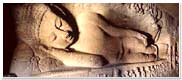
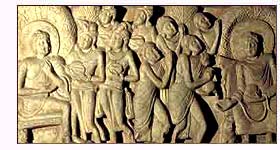
(temples) and mandapams(pillared pavilions), as well as some outstanding
examples of white marble depictions of the Buddhas life. The find were
reassembled on Nagarjuna Konda, an island in the middle of the dam.
Nagarjunakonda was one the largest and most important Buddhist centres in
South India from the second centuary BC until the third centuary AD. It was
named after Acharya Nagarjuna, a renowned Buddhist scholar and philosopher,
who had migrated here from Amaravati to propagate and spread the Buddhas
message of universal peach and brotherhood. The founder of Mahayana
Buddhism, this revered monk governed the sangha for almost 60 years and the
Madhyamika school he established attracted students from far and wide
including Sri Lanka and China.
We could get the following information from different sources and books on
Nagarjuna Konda & Buddhist Sites in India. Hope following information
will help and if you need more detail please feel free to contact us.
Nagarjunakonda may be named after Nagarjuna, the revered Buddhist monk who
governed, the sangha (community of Buddhist priests) for nearly 60 years in
the 2nd centuary AD. He found the Madhyamika school which studied and
developed the teaching of Mahayana Buddhism.
NAGARJUNASAGAR DAM
A feeling of awe and insignificance overcomes you when you lay eyes upen
the Nagarjunasagar Dam for the first time. Its sheer size and magnitude
leaves you breathless and astounded. As the tallest and largest masonry dam
in the world, it truly stands as one of the wonders of engineering
excellence.
Stretching across the mighty river Krishna, the barrage also has another
distinction to its credit-it has created one of the worlds largest
man-make lake.
Significantly, the creation of this lake has submerged the excavations that
were carried out here in 1926 which unearthed three historical sites
Dhanyakataka, capital of the Satavahanas, Sriparvata Vijayapuri, capital of
the Satavahanas; Sriparvata Vijayapuri, capital of the Ikshvakus and a
Buddhist civilization that thrived here in the third and fourth centuries B
C. What is of special interest to historians is the fact that the
excavations also revealed the existence of Brahmanical temples here which
indicate that Hinduism and Buddhism fourished together in peaceful
co-existence.
All the archeological findings and relics have been removed from here and
Carefully preserved on an island in the middle of the lake Nagarjunakonda.
The seven hoods serpant is called NAGA MACHILINDA .He Protects the Lord
Buddha when he is in Meditation. This Serpant carved in 4 Century AD by
Ishwaku Kings.
Location :
The site is located in Guntur District, at a distance of 150 km from
Hyderabad, the state capital. The Guntur District is located between
Latitude: 16º18'North and Longitude: 80º27'East
Attractions
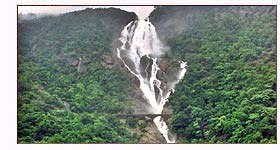
Ethipothala Water falls : The waterfalls are natural and
the scenic beauty of the place is mesmerizing, the Chandravanka river flows
down straight from a height of 70 ft, with hammering sounds and swift speed,
and thrashes on to a lagoon which, serves as a crocodile breeding centre.
So, you get another attraction for the time and price of one. The flow
rushes in to a deep green forest.
Ethipothala is a popular picnic spot, not only for the reptiles, but also
for the tourist folk.
Nagarjuna
Konda museum : The museum houses all the important excavated items
including relics by Buddha himself, stone images, Jataka tales encrypted
panels and many other inscriptions.
Nagarjuna sagar waterfall : The dam, which caters to
irrigation 10 lakh acres of land, is one of the largest man-made dams in the
world. In the middle it contains the Nagarjuna Sagar Island which houses a
museum.
Rajiv
Gandhi Wildlife Sanctuary : Situated between Nagarjunasagar and
Srisailam, Rajiv Gandhi Wildlife Sanctuary is a home ground to many types of
playful animals, the dreadful tigers and some of the rarest birds.
Excursions
Anupu : Mere a 4 km away from Nagarjuna Sagar, Anupu
became the virtual place to house the excavated pieces of artistic and
architectural items, as transfer of the items was necessary to save them
from immersion. Now, Anupu houses the university, the sacred Stupas,
Viharas, monasteries and an altar.
Srisailam : Located at an altitude of 1500 m, Famous for
the wildlife sanctuary, which houses the tiger reserve, there's also famous
for Mallikarjuna Swamy, Brahmaramba, Uma Maheshwara and Saraswati temples.
This temple is one of the Jyotiralingas and looks splendid as the ambience
is quite perfect and the lush greens add to the beauty of the surroundings.
The place has a "soothing the soul " effect and could serve as a
perfect break for the always on the go types.
How to reach there :
Air : Nearest is the Hyderabad Airport.
Rail : Macherla is the nearest railhead, 20 km from
Nagarjuna Sagar.
Road : Nagarjuna Sagar is located at 150 km from
Hyderabad, well connected by Road.
Where to stay
Hyderabd, is a good option for stay and easy travel assistance can also be
obtained from the city. The Taj Banjara, ITC Hotel Kaktiya Sheraton, The
Viceroy, Hotel Sitara, The residency, Tulip Manohar, and Hotel Taj Krishna
are good hotels.
 |
| Travel |
 |
|