BUDDHIST PILGRIMAGE |
|

|
AJANTA CAVES -
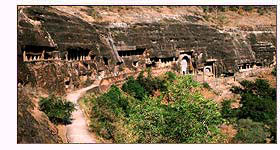
These
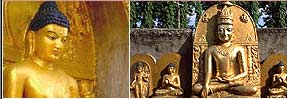
3rd-century caves are considered the finest masterpiece of Buddhist art and
architecture. These historical manmade caves comprise of beautiful paintings
on the walls and ceilings that depict the life of the Buddha. Visiting these
caves is like travelling back to the past. At Ajanta, the paintings on the
walls, illustrate the events in the life of Gautama Buddha.
These caves are believed to see the rise and spread of both the two sects
of Buddhism, the Hinyana and the Mahayana, and enough examples of
architecture are available still in the caves. The 30 caves, including the
unfinished ones, seem to carry a distinct charm and represent the true faces
of the flourishing Buddhist architecture, art, and obviously the religious
influence at that period of time.
The fact that
these caves were inhibited by Buddhist monks and religious devotees for more
than 800 years is, in itself, enough to support it become a UNThe fact that
these caves were inhibited by Buddhist monks and religious devotees for more
than 800 years is, in itself, enough to support it become a UNESCO world
heritage site. Even then, there are lots of other specimens to support its
uniqueness and importance in archaeology as well as history.
The location
The caves are in the state of Marathas, Maharashtra, 100 kilometers from
the city of Aurangabad. The caves are by the river Waghora, in the midst of
the Sahyadri hills burried by thick forest all around. The Ajanta Caves were
discovered by a British Captain, John Smith in 1819, while on a hunting
expedition.
Attractions
The Ajanta caves are important mainly to see the fine line of transfer of
the Hinyana and the Mahayana sect, as for the fact he Hianyana did not
worship any god or goddess but they used stupas, and other rock forms to
represent Buddha. Mahayana on the other hand, used idols of people they
worship. Interestingly, the caves include both Chaitya (Prayer Halls) and
monasteries and have both types of architecture and art besides paintings
and scriptures, of the two sects Hinyana and Mahayana. Caves numbered 8,9,
10, 12, 13 and 15 are of the older sect, Hinayana. Mahayana related vcaves
are numbered 1, 2, 16, 17, 19 and 26 where, 19 and 26 are Chaityas.
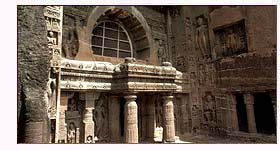
There
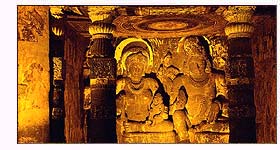
are some unsurpassable paintings in the caves 1 and 2, mainly depicting the
Jataka Tales. Buddha preaching in sitting position is the other common
example of sculptures. Cave 10 is also quite attractive for its Buddha
images and the depiction of Jataka tales. Cave 16 and 17 are monasteries
full with images of Jataka tales, child and youth of Buddha, the Sravasti
tales etc and are good examples of architecture. Caves 1,2,3,5,6,8, 14,
15,16 and 17 are Viharas or monasteries, 19 and 26 are prayer halls while
caves 20 to 25 were used for residential purposes.
Though all the caves are interesting to watch and noteworthy, if one has
only a little time in hand caves, remember 1,2,16,17, 19 and 26 are must
see.
ExcursionsEllora
caves :Ellora has 34 caves with fantastic rock cut sculptures and is in
the same district with that of Ajanta namely, Aurangabad. The caves are
always rhymed with the Ajanta Caves for the architectural similarity and
location. The cave is a symbol of representation of high tolerance of India
from the ancient days, as well as pointing towards the common thread running
through Hinduism, Buddhism and Jainism. The 12 Buddhist Caves depict Lord
Buddha in various poses. The 17 Hindu Caves embody carvings of the Hindu
Gods- Shiva, Vishnu, Durga, Parvati and animals. The 5 Jain caves include
figures of the Jain saints.
 Nasik
:
Nasik
: The green belt city of Maharashtra is well known for the 12-Year
Mahakumbh and the varieties of fruits produced here. The city is related
with Ramayana and is a very fast growing industrial destination in India.
Shirdi, Trmbakeshwar, Dudhsagar waterfalls, Bhandardara, Jawahar, etc.
How to reach
By Air : Aurangabad, 100 kms away is the nearest airport.
Direct flights available from Delhi, Mumbai, Jaipur etc.
By Rail : Aurangabad is nearest railhead, Jalgaon, 59 km
away, is good for catching swanky trains.
By Road : Well-maintained roads link Ajanta to Mumbai,
good buses are also available. Ajanta- 100 kms, Bombay- 390 kms, Ellora- 32
kms, Nanded- 275 kms, Nasik- 224 kms, Pune- 232 kms.
Where to stay
For accommodation, book your stay at